Humanoids From The Deep (1980)

<

h4>The chances are that, based purely on the title of this film, you’ve already made up your mind if you are interested in this film or not, as no one comes up with “Humanoids from the Deep” if they want to make things enigmatic and surprising. Names like that are meant to evoke a certain set of feelings, much like how these kinds of films are designed to evoke a set of emotions whilst watching them. It’s not meant to be smart; it’s meant to be an obvious signal of a specific kind of entertainment. It pretty much screams “this will be puerile and base, in the most amazing of ways!” and then holds out an open can of beer and a smoke to entice you in. The good news is that this film delivers on those promises, the only problem is that it’s intercut with two other films that manage to do both more and less.
Continue reading

IT: Chapter 2 (2019)


It’s a truth accepted in the horror world that any essential addition to the cannon can expect to get a not-quite-as-essential sequel a couple of years later. Something that tries to hit all the same notes of the classic, and add something to the story, but that just never gets as good as the first outing. Halloween did it by picking up a minute after the original; Hellraiser did it by adding in background plot; Friday 13th did it by switching metaphorical investigation, and now IT has tried to do it by running what feels like a lot of the same story with adults. It has a pretty good swing at it, all told, but it just never manages to reach the heights of the near perfect Chapter One.
Continue reading

Daybreakers (2009)


Here’s a question: what do you get if you cross vampires with sci-fi? Well, normally you get a disastrous bit of trash, like the awful Ultraviolet, or the “mostly remembered for the nudie scenes” Lifeforce. It’s probably because vampires are all about being spooky, mysterious, and asking “would you like a shag?” in assorted gothic ways, whilst sci-fi is more about ideas, explaining things, and answering questions that don’t need all your clothes taken off to answer. Still, if anyone was going to have a crack at making a good one, then Michael and Peter Spierig probably had the best chance with 2009’s Daybreakers. They had previously managed to mix zombies and aliens up to the delight of the lumbering dead fandom with 2003’s Undead, and that was in the middle of the zombie revival. Plus they were working in Australia, so they were cheap. Throw in Ethan Hawke, Willem Dafoe, and Sam Neil, and you’ve got a film that could have been a contender!
Continue reading

Equalizer 2000 (1987)


When I was first presented this movie, by Richard DeValmont of Bela Lugoi’s Shed, I assumed that it was both retribution for some vile act I had performed upon him and a test of my willingness to try any movie sent my way. The title and blurb were amazingly uninspiring, the figures on the cover were in the uncanny-valley of anatomical incorrectness, and the rest of the dressing was presumably pinched off a 4th years’ doodles from maths class. The back cover was even worse and accomplished the feat of having an even less realistic alternative poster on it, looking like a softcore BDSM flick, and having six photos from the film that can only be described as “punishingly uninspiring”. But instead of the 85 minutes of boredom I expected, I got the A-Team version of Mad Max, for better or for worse.
Continue reading

Starship Troopers 2: Heroes Of The Federation (2004)


In the latest shopping trip to the cheaper end of DVD sales, I noticed that there were several copies of the 2004 film, ‘Starship Troopers 2: Hero of the Federation’ in every shop I went into. This normally means that either a new box set has just been released or that it’s not a very good film. Given the pedigree of its predecessor, Paul Verhoeven’s 1997 exemplary satire “Starship Troopers”, I took a punt on it being the former. This proved to be wrong. Very, very wrong.
Continue reading


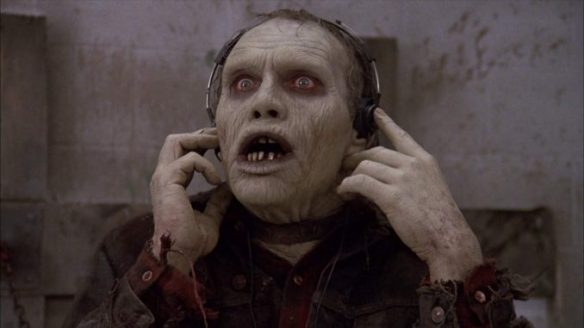
Thanks to Stranger Things, Day Of The Dead has gained a bit of an increase in its otherwise tepid reputation. Known mostly for being the final of George A Romeo’s original Living Dead Trilogy, it never gained the prestige of Night nor the hipness of Dawn. It was just “the third one”, and didn’t really get talked about. That’s probably due to it being so utterly downbeat and bleak, even by the standards set by the master of zombie cinema.

The main reason for this is that it doesn’t follow the three-act drama set by the previous two films. Both of them, for all their diversity and difference to each other, have three key beats: zombies turn up, the humans find sanctuary and then quarrel, the zombies get in and nibble everyone. Day doesn’t have this tempo, as it’s set in a post-zombie apocalypse world. It’s three acts are: the zombies have won, the humans have false sanctuary and are already quarrelling, and then… well, no spoilers. Let’s just say it’s all far less optimistic, far less positive, and somehow far more realistic than the others. It’s also far more satisfying, if you are willing to entertain something close to a nihilistic zombie Waiting For Godot.
Continue reading

She-Creature (1956)


Giving recommendations on movies from the early part of cinema history is always a tricky thing, because they all have a similar aesthetic that can’t be avoided. For a start, due to a combination of technical restrictions and the shadow of the theatre, the pace is always slow to modern tastes. The visuals of sci-fi and horror were also far more constrained, partly to avoid the censor’s knife and partly as the audience would be disappointed if either saw them in the full eye of the camera. The result of this is that old black and white films often fall into the pigeonholes marked “artefact of genre history”, for those seeking enlightenment, or “kitsch novelty items”, for those who like a good eye roll. Both miss the point that these films can just be fun in their own right. The She-Creature, a 1965 B-Movie originally on a double bill with It Conquered the World, is a great example of this. It’s not a might perfect movie, now as then, but it certainly has charms to offer a willing audience.
Continue reading

The Adventures of Buckaroo Banzai Across the 8th Dimension (1984)


The 80s were a gold rush of attempts to grab the MTV generation by the wallets, which explains how W.D. Richter ever got the money together to make “The Adventures of Buckaroo Banzai Across the 8th Dimension”. It was also the era of “high concept” films, which explains why it proceeded to do abysmally at the box office and then disappear into a lifetime of “The movie you wanted isn’t in, so try this…” sections of rental shops and the occasionally showing late night on cable channels. Over the years it got what could best be described as a quiet cult following, though more accurately it was a “doesn’t talk about itself much because it just takes too long to explain it” following. Not because it’s an especially intellectual or overtly strange movie, but because it’s ridiculous in so many different ways.
Continue reading

Nemesis (1992)


Let’s cut to the chase: does the line “86.5% [cyborg] is still human” send the kind of shivers down your spine that you haven’t felt since you were a teenager, imagining how wicked-ninja-cool it would be to live in a world of corps, cyborgs and corruption? If not, then this bit of contrived more-cyberpunk-than-cyberpunk nonsense from 1992 will bore the pants off you. If, however, it gets you revved up like the first assault rifle you fell in love with whilst thumbing through a hand-me-down copy of Guns and Ammo, then it’s quite possibly the film for you, depending on how much derivative, corny content you can put up with.

Continue reading

Six String Samurai (1998) Buddy Holly, Nuclear Mutants, and Fancy Swords

18
When people describe a film as having “a singular vision”, they normally mean something like the perfection of The Godfather, the scale of Heaven’s Gate, or the symbolism of 2001: A Space Oddity. They normally don’t mean “so bugnuts crazy, that it’s the only example of its genre ever likely to exist”, but Lance Mungia’s 1998 independent work Six String Samurai can only be described as such, because if there exists another post-apocalyptic samurai rock ‘n’ roll road movie homage of the book the Wizard of Oz, then I sure as hell don’t know about it – and trust me, I’ve looked!. Having seen it, you’ll understand why it’s a both a pity and a grace that this is the case, because it does what it sets out to do with so much style and swagger, and you’ll be convinced that no other attempt could ever get it so right.
Continue reading